
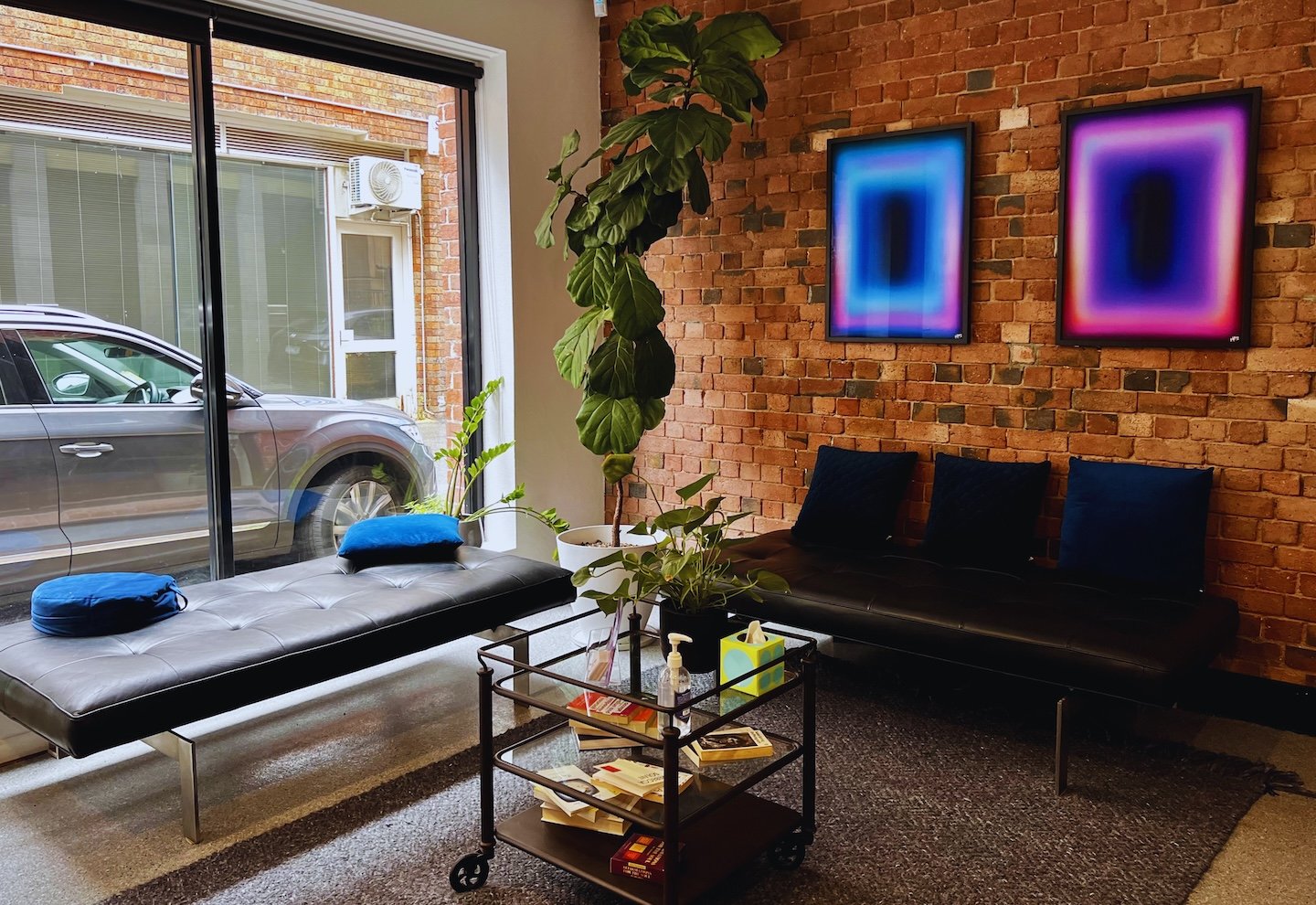
You don't have to explain yourself here.
Therapists who understand because they’ve lived it too.
Deep-specialisation therapy for people and relationships where lived experience and advanced training actually match your situation. We work with LGBTQIA+, polyamorous, kink-aware and neurodivergent clients every day. It’s not a niche we accommodate. It’s the practice we were built to be.
Prefer to talk? Call or SMS (+61) 0480 706 922
Serving Melbourne
for 7 years
9 Clinicians
Psychotherapists, Psychologists, Counsellors, and Social Workers
6 days
a week — online & in Carlton
EFT · DBT · EMDR · Schema · ACT
Advanced clinical training across the team
What brings you here?
Therapy is not one-size-fits-all.Neither are we.
Choose the path that sounds like you — each one explains who it's for, what to expect, and which of our therapists work in that space.
Individual therapy
One hour a week that is entirely yours.
EMDR Therapy
EMDR: when a memory still feels like it’s happening now.
Relationship therapy
Relationship therapy that doesn't make you explain ENM 101.
Kink and BDSM Aware Sex Therapy
Therapy that doesn't flinch.
Neurodivergent-affirming
No masking required.
LGBTQIA+ affirming
Queer-friendly therapy for people who don't want to explain themselves.
Medicine-assisted therapy
Considering a psychedelic retreat overseas? Learn the legal Australian pathway first.
Getting started
How it works
Tell us what you need
Take the 60-second match quiz or send a short enquiry. No forms that go nowhere.
A real person replies
Marissa, our practice manager, gets back to you within one business day. There's a free 15-minute fit call before anything is booked — no pressure to commit.
Start when you're ready
Online anywhere in Australia, or in person at our Carlton office six days a week.
The people
A team of specialists, one practice.




Fair, transparent fees
Questions, answered
Before you reach out
Everything else — fees, rebates, session formats, what first sessions are like — is one quick message away.
How do I get started?
Send a short enquiry through the website, or call or SMS 0480 706 922. Our practice manager replies within one business day with suggested therapists and available times. You can also book a free 15-minute fit call with a therapist before committing to a full session.
How much does therapy cost?
Counsellor and psychotherapist sessions use an income-based sliding scale: individual sessions range from $176 to $298, and relationship sessions from $215 to $440 depending on your income tier. Clinical psychologist sessions are $265 and mental health social worker sessions are $240, both with Medicare rebates available under a Mental Health Care Plan. NDIS clients are welcome.
Do you offer Medicare rebates?
Yes — with a valid referral and Mental Health Care Plan, Medicare rebates are available for sessions with our clinical psychologist (rebate $145.25) and our accredited mental health social worker (rebate $87.25). Counselling and psychotherapy sessions are private-fee with sliding scale pricing.
Can I do sessions online?
Yes. Most of our sessions are telehealth, available anywhere in Australia. In-person sessions run six days a week at our wheelchair-accessible office at 3 York Place, Carlton.
What if my relationship has more than two people?
We routinely work with polyamorous and multi-partner relationship structures. Sessions for three or more participants run 75 minutes, and our therapists are experienced in non-monogamous dynamics — you will not need to explain the basics.
Is Unison a crisis service?
No. Unison is not an emergency or crisis service. If you are in immediate danger call 000, or contact Lifeline 24/7 on 13 11 14.